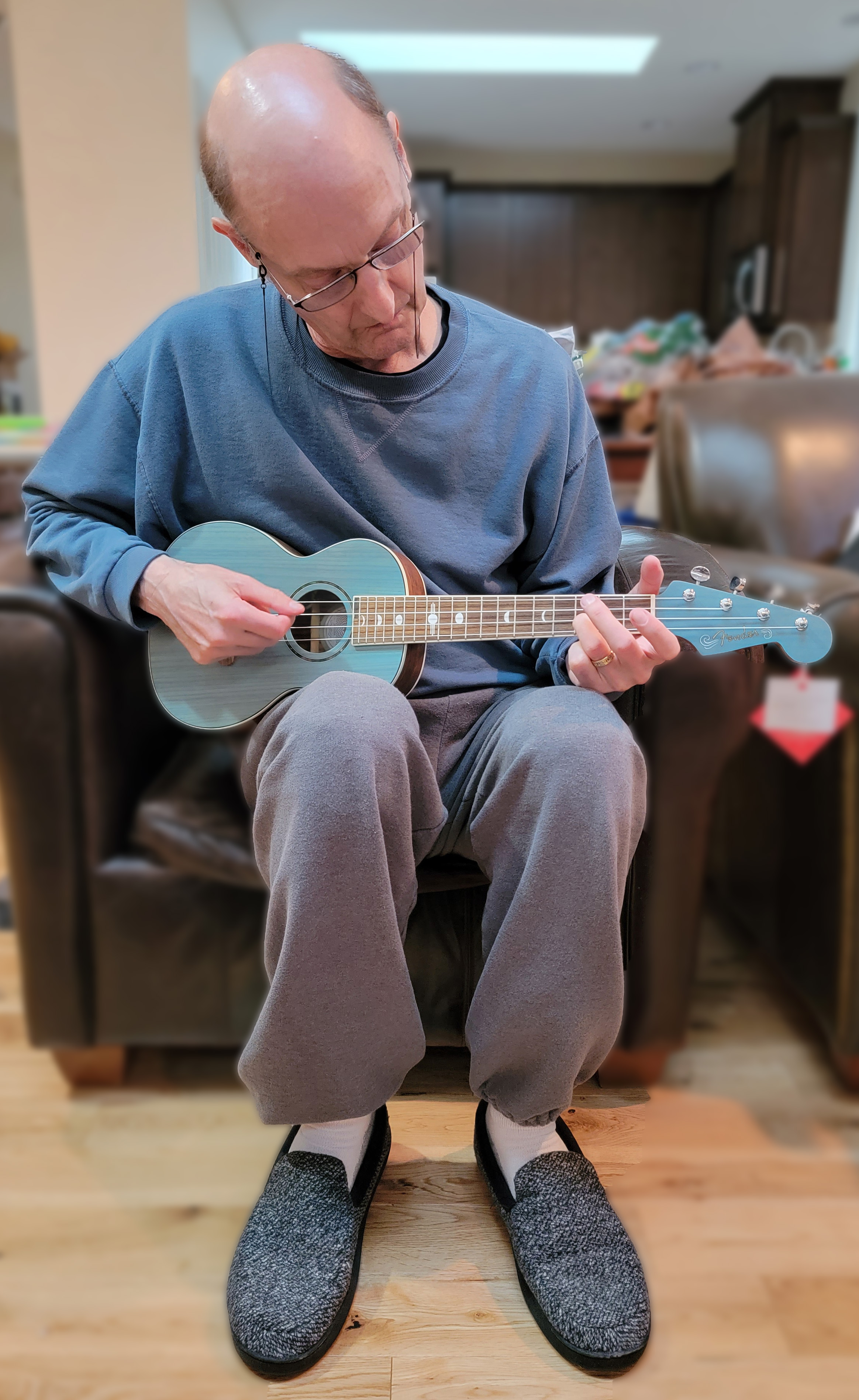
As treasured gifts to his wife, Keith took to compiling some of his journal notes on various subjects and would give them to her on special occasions like their anniversary or her birthday. Sometimes he’d read them out loud to her. She loved to listen to him read aloud and she sure wishes she’d recorded when he did.
These excerpts are about some of the many concerts and live music events they attended. Maybe you’ll recognize one you went to or heard about or avoided like the plague or read about in ancient history books (for those of you too young to have been there yourselves).
Still—it’s an enviable collection of musical adventures and reflects Keith’s determination to get out there and try new things and enjoy life to its fullest.
1988—Bored with the Vancouver bar scene, L & I & Jason & Dave H ventured across the river to a biker/blues bar called The White Eagle. The music was great!
1989—Tomorrow is the 30-million-dollar inauguration of (I shudder to say it) President George Bush. None of America’s hundreds of thousands of homeless and starving have been invited. I’m not going either. The Robert Cray concert (tickets to which L gave me for Christmas) is going to be at Portland’s Civic Auditorium that night. (Later: the concert was very good, seats were excellent, venue great, sound excellent—you could hear every note of that stinging guitar!)
1989 (caution! Link has curse words. Keith & friends can be seen in this video)—Last weekend we went to see Mojo Nixon with a guy from The Beat Farmers named Country Dick Montana. Dave Alvin (formerly of The Blasters) was supposed to be there too, but was sick. Mojo was as crude and as manic as one would expect. He sang “Debbie Gibson is Pregnant With Our Two-Headed Love Child,” then a version of “Jesus at McDonald’s” that was mostly about Oliver North. Then he exposed his nether regions through a hole in the seat of his pants.
Then Country Dick came out, a bearded, bearish dude in a cowboy hat and a fur-trimmed overcoat, waving a full Rainier like a baton (foam everywhere) and seeming very drunk.
They alternated, singing two songs each. Mojo sang “Elvis is Everywhere.” Country Dick sang a medley of Tom Jones songs (including, regrettably, “What’s New, Pussycat?”) and the whole thing ended with both of them engaging in a mock fight (a roadie acting as ref). Then we drove down to the beach, where we’d rented a cabin.
1989—It’s going to be a roller coaster of a Memorial Day Weekend: On Friday, L & I are going to the opening of an amphitheater at the Oregon State Fairgrounds in Salem. L won tickets. It’s a triple bill: John Hiatt, Stevie Ray Vaughan and Robert Cray! Saturday, we’re having a 50s-60s party. Ross is coming down. Monday: The Tailgators at Key Largo.
Our seats at the new outdoor amphitheater were great. The sound quality was great, the bands couldn’t have been more than 50 feet away (very great). And the bands? They were really great!
John Hiatt came out alone (“Howdy Doody, folk-music fans!”) with a big old acoustic guitar, and sang his guts out, wide-eyed wiseass songs about life, to a generally unappreciative audience.
It started to rain about ten minutes into Stevie Ray Vaughan’s set. After “Texas Flood”, he commented, “It ain’t flooding yet.” He played all of his songs that I knew—“Look at Little Sister,” “Change in the Weather,” covers of “Voodoo Chile,” and “Superstition.” Eternal guitar solos punctuated by an occasional vocal. Not much stage chatter. (Stevie Ray’s too cool for stage chatter.)
Robert Cray’s band played their usual laid-back set, but slightly funkier than their Auditorium show—perhaps due to new drummer? Hiatt came out for the encore and sang an old Sam & Dave tune (“If Something is Wrong With My Baby”) with Young Bob. I had been hoping that Stevie Ray would come out for a blazing guitar duel or two. But Stevie Ray was probably too cool for that.
Altogether a very fun show. Our main problem was keeping the people in front of us with umbrellas from blocking our view.
1990—L & I went to see John Lee Hooker at the Starry Night, in what had to be the hottest concert of the year—at least 100 degrees. (They’d oversold tickets and the place was wall to wall blues fans. The air conditioning didn’t work, and the walls were sweating.) The Blubinos and Back Porch Blues, two of Portland’s finest bands, opened.
Hooker came out, a skinny man dressed in a gray suit and trademark straw hat. His band was one of those “all-star” bands who always seem to be recruited from LA session players, that you see backing faded stars. It was only average.
I would’ve preferred to see him perform alone—when he played his mutant Delta slide and raised his deep voice, you knew it was real. Powerful. The band, with its eternal soloing, was just a distraction.
Beausoleil this month, if we can afford it. And B.B. King next.
1990—L and I went to a sock hop which featured The Kingsmen. They are a glorified bar band these days, playing mostly covers of 50s & 60s hits: old Sun singles and early Elvis hits. Even their performances of “Jolly Green Giant” (that was their song, right?) and “Louie Louie” were distinctly ungripping. But at least they seemed to have fun.
In our attempt to celebrate every ethnic drinking holiday known to mankind, L & I went out on Greek Independence Day. But since it fell on a Sunday, there wasn’t much going on. We didn’t get to smash a single plate. We did discover a couple of cool Portland bars, though.
1990—At Jubitz, a truck drivers’ bar across the river, the band was bad 50’s revival in obnoxious costumes. As usual, the crowd was relentlessly strange, including a wedding couple in full regalia (L estimated the tacky bridal gown cost thousands) and a few bridesmaids.
Then we went to a place called The Red Steer, another truckers’ bar located in the old livestock exchange building. The band was a non-professional country band—just some talented amateurs having a fun time. The décor was strange—lots of red velvet curtains, airplane models hanging over the bar, and the Mona Lisa replicated in butterfly wings. It was my first time there at night. Crowd older.
1991—On Saturday of that week, L & I spent a very Portland kind of day: lunch at Escape From New York Pizza, browsing in the recently-enlarged (!) Powell’s, a beer at the Metro (talking to Dave L, who was on break) and a late-night dessert at Rose’s. But the highlight was watching two of our favorite live acts play consecutive sets at Waterfront Park. Both The Blasters and John Hiatt restore my faith in live music every time I see them. The Blasters played a solid set, with Phil Alvin grinning that strange grin of his, as if he’s putting every ounce of energy he has out as sheer electricity. The man has presence. We sat right behind his cousin—whom, he said, taught him to play guitar. And when the cousin and his party went backstage after the set, we swooped in and stole their plot of grass.
When John Hiatt, came out, I thought everyone would relax—but instead everyone stood throughout his set. He played the same kind of solo show he played in Salem but this time everyone was there with him. He was funny and touching and rocking, the kind of concert that you walk away from smiling and shaking your head at.
And Johnny Cash was great at the Clark County Fair. He played a good chunk of his early stuff, including “Big River” and “Wreck of the Old 97” and “Get Rhythm.” (The idea for which, he said, came to him while he was (surprise!) getting his shoes shined. It was an older man shining them, and Johnny commented that he didn’t seem to pop his rag as much as the younger men. The man replied, “That’s the problem with the world: there’s too much popping and not enough shining.”)
The Carter Family sang a few songs (“Will the Circle Be Unbroken”) and Rosie Carter (Jimmy and June’s youngest daughter) sang Amazing Grace. June Carter was really pretty funny, and the whole thing was very enjoyable.
1992—Tonight was to be my birthday celebration (for the third time in eleven years, my birthday has been edged out by Easter.) But I’m sick, and alcohol would only make it worse. Damn.
1992—What the hell. We went out that night anyway, and I didn’t get sicker—in fact I feel better. We went to a few bars in Portland: first The Red Steer, then The White Eagle—one of our favorite bars: an old brick building with a beautifully carved backbar that came around the Horn on a sailing ship. The bartender was telling us about its resident ghosts. (We’ve been going there for years, but never knew until recently that it was haunted.) They call the ghosts Sam and Rose. The bartender’s only experience of them was of being downstairs in the office when the bar was empty and hearing the click of the well gun and seeing bubbles rise in the transparent wells—which it only does when drinks are being poured. Other people have told him of being in the ladies’ room next to an empty stall and seeing toilet paper start reeling onto the floor.
When the band (Mystery Train) finally started, one woman was trying to dance with every guy in the bar. She danced alone if she had to. Finally, she got some guy to dance with her and after the dance he begged off and went into the bathroom. After a pause, she followed him. Almost immediately, she came out again, followed by the manager. Very funny. Later she got kicked out for climbing onto the postage stamp-sized stage.
Afterwards, we went to the Metro (which is sort of a hip food court) and said hi to Dave L and Joe, who work there. Then Jubitz, where we saw a bad country band. L didn’t get pinched once.
Today, to top off my birthday L & Vikki & I went to see what was surely the worst Elvis impersonator ever to walk the face of the earth. He was a paunchy middle-aged pharmacist who sang all of Elvis’ worst songs in a flat voice to recorded accompaniment. He wore a poorly-made imitation of Elvis’ white rhinestone jumpsuit, and for some songs he wore an ugly pair of gold-framed sunglasses.
There weren’t many people in the bar, and after he finished the song he was singing when we came in, he walked directly to our table. “Fresh victims,” he said. I, not knowing what to do and feeling sorry for the guy, shook his hand. Then he took off a blue scarf that he was wearing, wiped the sweat from his forehead with it, and draped it around L’s neck. “This is for you, baby,” he said. “I want you to keep it.”
Then he tried to move her head toward him with the scarf so he could kiss her on the lips. L being uncooperative, he settled for kissing her on the cheek and (L swears) licking her.
“Don’t worry, darlin’,” he said, smiling greasily across at Vikki, “I won’t forget you. I’ll be back with another scarf in a while.”
In the face of that, it was inevitable that we didn’t last long. L & Vikki drank down their cokes and then spent their time encouraging me to drink my beer faster. Vikki looked straight ahead, trying not to laugh.
A middle-aged woman (his wife?) moved behind him on stage, operating the tape player and handing him new scarves. Probably she also sold the CDs which he talked about, “which include Elvis’s fourteen best songs. I sing duets with Elvis on some songs.” (I wonder if RCA knows about this?)
A small flock of rapt older women (all with blue scarves) looked on with adoration. Sometimes one would shout, “Elvis!” One woman (whom he kissed full on the lips) absolutely screamed, the sound amplified by the mic. I couldn’t tell if she was shocked or thrilled until she danced away a moment later.
Finally, I finished my beer and we fled, afraid he would try pathetically to stop us from the stage. We ran laughing to the car. All in all, a very good birthday!
If you think about it, Easter was an appropriate time to see an Elvis performer (as he called himself.) Resurrection of a fertility figure. And Elvis impersonators are sort of a society of priests which are symbolically possessed as they act out his performances in ritual costume.
1992—Yesterday was Sheila’s 21st birthday, and we took her around to some of our favorite places—Jubitz, The Elephant & Castle (a dark-paneled pseudo-Brit pub), The Alexis Restaurant (a Greek place.) Other favorites of ours: The White Eagle, upstairs at The Moosehead, the cavernous Pine Street Theater (now deceased), Cap Ankeny’s (in the mezzanine of a deserted marketplace—now yupped out. Our favorite night, we saw a black guitarist leading the entire bar (6? 8? people? Tiny) in a singalong of 60’s songs), Starry Night, Day for Night (also deceased), The Metro (not a bar, but beer is available), Key Largo, The Fox and Hounds (another pub, with English and Irish newspapers), The Red Steer, The Alibi (kitsch galore.)
Usually, L & I top off an evening with a trip to The 24-Hour Church of Elvis (and World’s Cheapest Psychic.) Which, alas, has fallen on hard times. L bought me a C of E (Elvis, not England) T-shirt last week, and yesterday we made a donation to help keep it going. I mean, sure, Elvis is Everywhere, but sometimes it’s just darned handy to have a direct line to the King—confessions, marriages, even past-life regressions. And all for only 25 cents!
1994—We went to the Clark County Fair last night. It’s funny how much I enjoy the animal exhibits these days. They make me smile. Saw Merle Haggard—very pleasant. Good country music, stars above and amusement park lights. He sang a lot of slow songs because he had a sore throat.
1995—Last Thursday’s Radney Foster concert at the Aladdin started slow (we think he was disappointed by the small crowd) but built, and he redeemed himself. Great versions of “Went for a Ride”, “Hammer and Nails”, and “Crazy for You.” During the last, he danced almost as much as he used to, and actually jumped off the stage and danced with a girl from the audience. (A Foster and Lloyd tradition. No bluegrass Zeppelin, though.)
After the show, at about 11:30 pm, the truck broke down under a bridge in the middle of an urban light-industrial wasteland. I had to leave L & J and jog ten or twelve blocks to find a payphone in the rain. I called AAA and ran back to find L & J (gratefully) just fine.
A cop came along and waited with us. The tow truck was late. I was a little anxious that someone might run into us, which had almost happened at least a couple of times—the truck was about three feet from the curb. Finally, a tow truck showed up and the driver grudgingly took us to a truck stop that turned out to be only a few blocks away. Another driver would come get us, he said (he didn’t want to drive all the way to where we lived). But one of us would have to find another way home, because the cab only held two passengers. (Sound like Texas?)
L called a nearby friend (typically up late) who was far from interested in coming to get us. He was more interested in discussing what might be wrong with the truck—with us standing at a payphone in the cold and steady rain. Before L could coerce him into doing the right thing, the next tow truck driver showed up. “I think we can fit you all in,” he said.
It took him forever to hook the truck up—he seemed to be having problems. “Did the other driver hook it up like this?” he asked me. Finally, we piled into the cab (me sitting on L’s lap, arms braced, trying not to put any weight on her poor knees. My head was bent sideways because of the low roof.
Our truck bumper scraped on our way out of the driveway. The driver pulled out, adjusted it, got back in. Then a car swerved around us and flipped us off when our driver honked. We pulled alongside them and believe it or not, the driver began to calmly explain to them that they had been in our lane. L & I exchanged glances. “Oh my god,” I thought, paranoid from exhaustion. “He’s giving driving lessons to a carload of itchy-fingered psychotic gangbangers. We are going to die!”
It was a phrase that would run through my head more than once in the next hour. But as I crouched, waiting for the inevitable barrage of gunfire, I heard the driver of the other car, say, “Oh…sorry.”
The freeway was even scarier. Due to snow and ice for the last couple weeks—followed by flooding—tow trucks had been extremely busy. It turned out that our driver had been on the road for over eighteen hours. He kept swerving across lanes, and once when a big semi cut us off, I was certain he was going to pull it over and give the trucker a stern traffic safety lecture.
We were tired, too, by now. But we kept talking to him, saying anything that came into our heads. Anything to keep him awake. He got worse the further we went. I counted mileposts the whole way. We had to talk him through to our exit—“Okay, we’re going to curve gradually to the left—no, left—and now to the right…”
When we finally got home, it was 3:30 am. I was still soaked to the bone, my feet were bruised from running in cowboy boots and my neck and shoulder muscles were in agony, but L & I were giddy from just being alive.
1996—The same night that I quit my job at the bookstore, L & I went to a bar in Raleigh which was holding a festival called S.P.I.T.T.L.E. (Southern Plunge into Trailer Trash Leisure & Entertainment.) After about three hours of neo-cowpunk (and Whiskeytown, which we called “The Tuning Band”) rockabilly semi-legend Sleepy La Beef came onstage. He was a big guy who had just walked in the front door a couple hours before his set and stood around talking to people. He had a deep voice and played a great rockabilly guitar. He was the real deal. Like L’s dad, he’d do a couple verses of something and then effortlessly slide into something else—gospel, country, R&B. He did “These Boots are Made for Walking” and “Ain’t Got No Home”—even the falsetto part. Best segue: From “Okie from Muskogee”, where he changed the lyrics to “White Lightning’s still my favorite George Jones song”—and then went straight into “White Lightning.” The whole set was totally fun.
1996—The big news around here musically is that Jerry Lee Lewis came to town. It was announced that he’d be at The Longbranch, a country music club in Raleigh. So one night while J was at a NCSU game, L & I went to buy memberships. The chance to see JLL in a bar really excited me—I mean in Washington or Oregon you see people like that in arenas and amphitheaters. Ray Charles plays opera houses. But to see a rockabilly legend in a bar was perfect! (Plus, the man was Number One on my Life List (remaining, since you ask, are Chuck Berry, Fats Domino, Aretha, Ray Charles and B.B. King.)
But the week before the show L heard on the radio that JLL was also going to appear at a little rural sports arena in the next county. Dilemma: one venue presented him in a real rockabilly environment (or so I imagined) and the other allowed kids—and J wanted to go; picked it over a chance to go see a new band called Del Amitri. (Are you impressed?) And of course, we wanted him to have the opportunity—what a cool memory for him to have twenty years from now!
So we decided to go to both. It’s not something we’d ever done before—seeing the same performer on consecutive nights. But we seriously doubted that he’d play the same show twice—and man, were we right. The two shows couldn’t have been more different.
The first concert was at The Longbranch. We’d never been inside before, just at the desk in the entryway to buy memberships. The line was short. We picked up our membership cards (there’s a statewide three-day waiting period), let the two ladies in line ahead of us in as guests, and entered for the first time.
The place is a big sprawling honky-tonk with five bars, an enormous dance floor by the stage and a smaller one for two-step lessons. It has its own western wear shop and dozens of autographed 8x12s on the wall (Garth Brooks and Foster & Lloyd included) all thanking The Longbranch. A radio station was broadcasting from inside, and (since the club sells no food whatsoever) a hot dog wagon lurked outside. And all of this is just on the country side: the other half of the building features Top 40 and beach music.
We actually snagged one of the last tables and had fun people-watching. The waitress said that there weren’t many more people than usual on a Saturday night. And most of the people there did look like regulars—hats, boots, jeans and so many striped shirts that I kept humming Johnny Cash’s “I’ve Got Stripes.”
By the time Jerry Lee’s band came out to warm us up, it was about 10:30 pm. They played uninspired renditions of some old R&B numbers. They were in the middle of “Baby What You Want Me to Do?” when The Killer came out. And suddenly it was a whole different ballgame. There was electricity in the air. The man has presence, and when he let loose with his trademark snarl and evil laugh and, my god, started playing piano like no one else, it was just amazing. He just tore the place up.
He sang an amazingly cool version of “Somewhere Over the Rainbow”, some 50’s standards, and some of his 70’s hits that I didn’t know. He was so good that I didn’t care what he played. He had a rowdy and appreciative audience and he was having fun. And it’s always fun to watch someone having fun. I smiled so much that my cheeks hurt.
(The audience was so rowdy, by the way, that there was at least one fight. A guy from the next table—who changed girlfriends at least twice that night—got into it with some other guy, and L said he was lifting a bottle when they pried it out of his hand.)
Anyway, L & I had a great night. We danced during the encore (“Hi Heel Sneakers”, I think) and left very impressed.
Night Number Two was at North Carolina Indoor Sports Arena. We drove out into the sticks until we saw a yellow sign (surrounded by flashing bulbs) that said “Jerry Lee Lewis Tonight 8 pm.” We parked in the dirt lot and went inside. The place had bleachers on three sides of an area about as big as a basketball court, with the stage on the fourth side and a few chairs down front. Behind them, plywood had been laid down as a dance floor.
We came late in the opening band’s set. They were a local band called Dakkota, and all I remember of them is a slow version of “Dixie” leading into “Sweet Home Alabama” (which they sang as “Sweet Home Carolina.”) As we were standing around waiting for them to finish, a woman in her 40’s came up to us and asked, “Are y’all married? I was just asking because no one wants to dance. I don’t suppose I could borrow your husband…”
L shook her head. “But you can borrow my son,” she said. J turned bright red and spent about half the song resisting her attempts to drag him onto the dance floor before she gave up in disgust.
We got good seats, but there were dozens of empty ones in front of us. In fact, the place was about 2/3 empty—not surprising considering that they didn’t advertise it in the local newspaper. L had only happened to hear it advertised on the radio the week before.
“Lewis’ show will depend on the volatile Killer’s mood,” that week’s ‘Raleigh News & Observer’ had said. “If he’s up, it could be an evening that you won’t forget; if he’s down it could be an evening you’ll regret.” We’d taken that into account when we bought tickets. We figured it would up our odds of seeing a good show—and now that we had seen a good show, I was apprehensive (especially for J’s sake) that now we’d have to pay the piper.
I became even more apprehensive when his band came out. They played the same songs in the same order as the previous night. Jerry Lee didn’t come out during the same song as the night before. At the song’s end, they put a white spotlight on stage right and the band all turned to look. No Jerry Lee. “Well, Jerry Lee will be out in just a minute,” said the guy who seemed to be the bandleader. He was a middle-aged guy named Kenny with big (and I mean BIG) hair. “But first, we want to play you a little song called…” Uh oh, I thought. The Killer’s in a mood. At the end of the song, they turn on the spotlight again; and Kenny says the same thing, seeming a little more nervous. They play another song; the audience is getting restless.
Finally Jerry Lee came out. He played a couple of songs that he had played the night before: “Somewhere Over the Rainbow” and (I think) a Chuck Berry song. No chuckles of evil glee, no showing off. He played some old gospel numbers. “Will the Circle Be Unbroken.” In between songs, he talked about how some people think his shows are too short. (We later find out that he’s pissed because the owner had announced before his set that we shouldn’t leave afterwards, because the opening band would come out again.) He also talks about money (he even plays “Money”—he must be in bad shape financially, because his fan club applications say to make your check out to the Jerry Lee Lewis Tax Fund.)
The redneck audience was getting restless. “Shut up and play something!” yelled some guy behind us. They wanted to hear an oldies show. They would rock out extravagantly when he played a rocker, and fume when he played something they didn’t know.
Jerry Lee knew exactly what kind of mood the crowd was in. He didn’t care—in fact, he teased them. He played the first verse of “Great Balls of Fire”, rocking it hard. The crowd came alive—and he stopped. “Gotta work up to that one,” he said. “We’ll play it later.” But he didn’t.
And later, he was in the middle of “Whole Lotta Shakin’” when somebody tossed a hat onstage, he stopped again, and started something slow. People left in droves.
It seemed to me that he was baiting the audience. Since we’d seen last night’s show, seen the show this audience wanted, it was like we were in on the joke. It was like watching a lion tamer; it was a contest of wills between Jerry Lee and the audience, and L & I were cheering for him.
Who won? Jerry Lee, of course. What did he play? Any goddamn thing he wanted to. And it all sounded great. He could’ve played anything at all and I would’ve enjoyed it. And he played some strange things.
He did 50’s standards: “Lucille”, some Chuck Berry songs, “Chantilly Lace”, “What’d I Say”, “Crazy Arms”, “The Lewis Boogie”, “Blue Suede Shoes” (“I wrote that. Carl Perkins stole it from me,” he said jokingly.) Snippets of “Mr. Sandman”, “Bye Bye Love,” and “All I Have to do is Dream” (“by the Everly Sisters.”) Even “A Hard Day’s Night.” He did his 70’s hits, he did country (“Blue Moon of Kentucky”, “In the Jailhouse Now,” “Roomful of Roses”).
His band limped along behind him, driven forward by the madman at the piano. Usually they faked along well enough. But he had to teach them the changes to “Goodnight, Irene.” (“Play it right,” he growled at the drummer.)
If he got bored with a song, he’d simply stop and go on to something else. It reminded us all of L’s dad who never in all the times I saw him sing finished a song. Jerry Lee’s physical resemblance to her dad was amazing, too. The older he gets, the more alike they look. When we got close to the stage near the end of the show, L said that every time he turned to face the audience, it seemed strange to her that his left eye wasn’t glass. He also has her dad’s hand gestures, sweeping yet vague. The resemblance is almost uncanny.
Early in the show, his declaration of independence—his warning to the audience that this wasn’t going to be a normal show—was when he did “White Christmas.” (“Merry Christmas!” he said afterward. This in February.) He followed it with “Rudolph the Red-Nosed Reindeer” (no kidding!) “He’s only about half a step from ‘Peter Cottontail,’” I told L. She nodded. She’d been thinking that, too: “Peter Cottontail” was a particular favorite of her dad’s. And what was the next song that ol’ Jerry Lee sang? “Peter Cottontail.” It was very weird.
He also sang “Sweet Georgia Brown” and (of all things) “Mammy.” I was thinking that this was one of the strangest concerts I’d ever seen.
The stadium owner kept trying to get him off the stage. “Mr. Lewis is going to sing another song or two for you,” he announced at one point, about an hour before the end. Fat chance. Jerry Lee was having fun, now. All the doubters had weeded themselves out, leaving only the true believers, and it became less like a concert than like watching a jam session in someone’s living room.
He did a sweet “Georgia on my Mind” and ended with a really long “Whole Lotta Shakin’” (in the middle of which he borrowed a guitar, sat down on the keyboard and picked out “Folsom Prison Blues.”) Then he apologized maliciously for playing so long, and (after a couple of false starts) left the stage. The owner practically had to drag him down the steps. I remember him leaning forward against the handrails with the owner below him, looking as if he might go on again after all. Drunks were climbing the tubular livestock fencing that demarcated the backstage, yelling, “One more, Jerry Lee!”
He’d played for three hours—twice as long as the night before. The next day we counted up 34 songs (plus four snippets) that we could remember him playing—and those were just the ones we knew! About ¾ of the total, maybe. (Actually L probably knew them all—she knows nearly every song published in the last fifty years—but these were only the ones we could put names to.) The “News & Observer” was right about the show depending on Lewis’ mood. But L & I loved both shows, different as they were.
I was especially pleased and proud that J enjoyed the concert. He and I followed as JLL got into an enormous pickup (double cab, all the options) and rode around to a singlewide trailer. We waited for more than an hour in the cold on the steps. People kept drifting in and out. The guy behind us was a writer for the Fayetteville paper. We talked records, and I told him about the previous night’s show.
We could hear Jerry Lee singing through an open window. After a long time, he came out. J was first in line, and told him that he’d enjoyed a show. JLL signed a record cover for him (actually an old one of mine), then a piece of paper for another guy and a CD insert for me.
He was talking to no one in particular about his wife (to whom he’d been speaking on the phone.) He was fairly drunk. “She doesn’t understand how I think,” he said.
“That could be a good thing, right?” I asked.
He considered this. “Well, but the problem is, I don’t understand how I think either.” Then he turned and looked at me just like L’s dad used to do (only with one more eye) and asked me the same question D would ask: “What do you think about that?”
My mind went blank, just like it sometimes did when D asked me things. “Well, I’m no psychologist…” I said.
Dumb answer. He immediately lost interest in the conversation and let his entourage hustle him off. I took our pen back, he signed a couple of records and answered a couple questions for the reporter. Then he got back in the truck, which drove him about 50 yards to his limo.
All my Southern training had failed me. I didn’t call him “sir,” I didn’t thank him for the autograph and I choked when he asked me a question. My biggest regret is that I didn’t shake his hand—that would’ve made a hat trick of Sun artists that I’d shaken hands with.
When J & I got to the car (freezing) the lot was empty, and we ended up driving back to Sanford behind Jerry Lee’s limo (on its way to the Sanford airport). We couldn’t keep up with it for very long, though, since it was doing about 85. Soon its tail lights disappeared around a curve. We got home at about 2 am, satisfied.
1996—Got up early Saturday to go down and buy Jimmy Buffett tickets. (Now I remember why we don’t go see people in arenas anymore.) Buffett is apparently big around here—I remember reading about last year’s concert soon after we moved here. He’s playing two outdoor shows this year (Hardee’s Walnut Creek Amphitheater) and all the seats were sold out before I even got up to the desk, so I bought lawn tickets. It was cold out, but the crowd was so friendly that I was actually invited to a party the weekend before the concert—which is five months away.
1996—This year was my 36th birthday. Another year older and another year slower. L came home from work early and L & J showered me with gifts. J gave me an Abbey Road CD and a desk set. L gave me a cool new journal, a pair of great sunglasses (Wayfarers, even!), a mug with Dickens on it and (drumroll please!) a trip to Nashville to see a Foster & Lloyd reunion/album release party! Very cool.
1996—The Nashville trip was great, even if it was a lot of hard driving. We left Thursday evening and spent the night in Asheville. Then, with little happening on the way, we checked into the Clubhouse Hotel in Nashville (surrounded on three sides by buildings owned by the Baptist Church, which is headquartered here in Nashville—one was the Baptist Sunday School Board).
We ate dinner at the hotel and I busied myself with disposing of the free drink tickets they gave us. Spent some time in the lounge, which was friendly and remarkably free of suits.
Then L & I drove to a bar called The Exit/In. Advance tickets hadn’t been available, but the bar manager had promised us entry, since we were driving all the way from NC—L’s doing, of course! We stood near the back. The opening band (The Thompson Brothers) was pretty good. Bill Lloyd introduced them and later helped set up.
Then Foster & Lloyd played. The band was tight—especially weird since the two of them hadn’t played together for six years. Backing them were a few old band members, one of Lloyd’s bandmates from his new band and (oddly) Gary Tallent from The E Street Band! Their set was great fun. They opened with “Faster and Louder” and did a bunch of their old numbers. Foster and Lloyd barely played off each other, but it was all fun stuff. They also did covers of “Baby What You Want Me to Do?”—that song that Jerry Lee sang—and “Rave On” (during which they were joined by Southside Johnny Lyon, of all people).
The crowd was really into it and fairly friendly. We introduced ourselves to the manager and thanked him. But I had to threaten to punch some guy in the nose for bashing into L once too often.
After the band did three encores—and finally quit because they’d run out of tunes—the crowd dispersed almost immediately. Foster & Lloyd came out and stood at opposite ends of the dance floor, talking to people and signing autographs. Foster seemed distracted; Lloyd seemed shy. He was wearing a Big Star T-shirt and the same suit he always wears.
L asked a roadie if Gary Tallent was coming out. He emerged a few minutes later, saying, “You want my autograph?”
When I went to ask Southside Johnny, he saw me standing at the edge of the stage and playfully shouted, “What? What do you want?” at the top of his (considerable) lungs. L says all conversations stopped, and everyone turned to see what was happening.
I’d had about six Shiners, and God knows how many of those little plastic jiggers of beer that they gave me at the hotel, so I just shouted back, “I want your goddamn autograph!”
“Oh,” he said meekly. “Okay.”
“What the hell are you doing in Nashville?” I asked.
“Visiting Gary—he lives here now. You want his autograph?”
“Already got it. It’s on the other side.”
He examined it. “Oh yeah. Didn’t cross his ‘T’, though. Very sloppy.” And he made a mark on the paper. Which is why Gary Tallent’s ‘T’ has been crossed twice.
A bizarre evening, but very fun. And just the coolest birthday gift!
1997—Summer is almost here, and that means concerts and lots of them in Portland. Festivals, fairs, blues at Waterfront Park. We’re planning on seeing Jimmy Rogers (the Chicago blues legend, not the “Honeycomb” guy or The Singing Brakeman) at Key Largo this week. Willie Nelson is supposed to be at the Clark County Fair this summer. Doc Watson at Oaks Park on Fathers’ Day. And the ’97 Waterfront Blues Festival is having The Staple Singers and Boozoo Chavis. Then there are all the summer concerts and cheap festivals. And don’t forget Bumbershoot!
1997—We bought tickets to Jimmy Rogers the night before the concert. We had to drive across town to do it, and almost ran out of gas.
The next morning it came to me while L was getting ready for work that while I never mix Jimmy Rogers up with the other Ro(d)gerses, I do mix him up with Jimmy Reed, who (as I found out) actually did all the songs that I wanted to hear—and who had died in the ‘70s. Oh well, it had been a long time since we’d gone out to see a band, and much longer since we’d seen a blues band. So we went and had a terrific time.
It must’ve been a last-minute event. I’d seen a three-inch article in “The Columbian” and only a calendar listing in “The Oregonian.” Nothing in “Blues Notes.” The place was practically empty when we got there, only a half hour before curtain. The band came out and played a few numbers, then some Cascade Blues Association bigwigs (the CBA president and a DJ called “The Big BA”) came out to present Rogers with a “Muddy”—the CBA’s version of the Grammy, a gold-plated bust of Muddy Waters (with whom, along with Little Walter, Rogers had been in Chicago’s first electric blues band).
Then Rogers started playing with his band—he was very likeable, a good entertainer. L & I enjoy seeing old musicians—they feed our sense of history, and I think they remind L of her dad.
Bad dancers were out in force. There were the obligatory (for the NW) “floaters”—one of whom stood rooted in the middle of the empty dance floor and did his head-rolling, arm-flailing thing. Then there was the middle-aged guy in the suit who stood right in front of the stage and did these Fred Astaire moves—sideways glides, etc. But our favorites were a couple in their 40’s who did the oddest combination of steps—sometimes it looked like the cakewalk, sometimes it looked like they’d just seen Riverdance. They were actually pretty good at it (really good bad dancers) but the whole effect was so dopy that you couldn’t help but laugh. They were taking up a good chunk of the dance floor and running into people.
L & I even danced during the second set to the only song of his that we knew—“Walking By Myself.” Then we left during a pretty hot “Got My Mojo Workin’” (L had to get up early next morning, and anyway we’d pretty much experienced it.) The whole thing was pretty fun. It was good to be back in a Portland bar—brick walls, good ale and good music, and damn few yuppies.
1997—Last night, L & I went to Portland for the Cascade Blues Association’s monthly meeting. I rejoined. I had been a member back in ’89 or ’90—which would’ve been when the CBA was two or three years old, since this is their tenth anniversary.
I joined because there doesn’t happen to be a Blues/Country/Rockabilly/Old R&B/Roots Rock/Soul/Folk/Celtic/Zydeco club. I also joined for the social aspects—people are friendly and show up at almost every concert you go to. L & I need some good, outgoing friends, and this may be the place to make them. The meetings are really more like parties. Microbrews are on tap, two or three bands play during every meeting, and they spend most of the rest of the time giving away prizes—CDs, T-shirts, tickets.
I’ve done pretty well in the drawings. The brass Seth Thomas clock hanging in the dining room, I won at—hell, it must’ve been the Christmas party in ’89. I won an autographed Big Daddy Kinsey record at a concert. And last night I won a ticket to see someone named Sonny Rhodes at the Cascade Tavern. The membership cost $15, and the ticket cost $7. So it looks like I’ll come out ahead—especially since later this month is the CBA picnic—free food and Widmer Beer!
L didn’t want to be a member. She wants to go to the functions and stuff, but says if she joined, she’d end up running the whole organization. Which is probably true, since capable people always get asked to do more and more. Myself, I don’t have a worry in the world! Although I am flirting with the idea of doing a little volunteer work, just to meet people.
1997—I’ve been meaning to write about summer concerts; it’s been a good year for them.
Especially for Texans: we saw Willie Nelson at the Clark County Fair, Jerry Jeff Walker and Robert Earl Keen at the Aladdin in the same week, and even Don Walser at Bumbershoot. Jerry Jeff I saw alone, because L had to go pick up John at the airport. His fans were rabid—seriously into it, singing along and dancing in the aisles. I’d thought he was past his prime, but apparently not. He put on a damn fine show. Sang “Up Against the Wall, Redneck Mothers” twice for some reason—and the crowd loved it, chanting together a call-and-response which proved that most of them must’ve been to his concerts before, since it’s not on the album: “Mothers who have raised their sons so well.” “So well, so well, so well.” “He’s 34 and drinking in the honky-tonks” “—What’s he doing down there?” “Just kicking hippies’ asses and raising hell.”
Robert Earl Keen’s concert wasn’t as exciting—it was his first trip to Portland—but his band was really tight and the acoustics were so good that you could understand all of his wry lyrics. The man’s a good storyteller. Great versions of “The Road Goes On Forever” and “The Five-Pound Bass.” Also “Merry Christmas from the Family.”
Willie’s concert was a kind of homecoming. He used to live here, and was a DJ for KVAN radio (that’s the one that L was on last month, plugging Get-a-Life Services—and she’s going on again next week.) That was right before he moved to Nashville. He had a daughter born here, and also recorded his first record here—a 45 that he hawked over the air.
I thought for awhile that we wouldn’t get to go, because it was announced that tickets were $18. But then I found out that that was only for the “Gold Circle” (on the ground nearer the stage) and the stadium was free with fair admission. So the people on the ground fried while we sat in the shaded bleachers.
Most of the show was pretty standard (judging by what I’d seen on “Austin City Limits”). But towards the end it really picked up. He kept leaving the stage and coming back, or stopping in the middle of his farewells to say, “I just remembered another song!” or “Hey, do you want to hear some Hank Williams?” He did “Will the Circle Be Unbroken,” “I Saw the Light,” “My Bucket’s Got a Hole in It.” Hymns (“Amazing Grace”), old hits (“Luchenbach”)—even a pair of reggae songs (“The Harder They Come” and “Sitting Here in Limbo”). The whole thing was very cool.
Bumbershoot was good this year. We stayed at Jason’s (he was in Denmark.) Ross and I went on Saturday, and so did J and Shawn. On Sunday, L & I went alone. We saw Terrance Simien, Wilco, James Cotton, Don Walser and The Neville Brothers. I would’ve paid to see any of them, and saw them all for only $8! Sunday highlights: Seeing The Bhundu Boys (a drum-heavy band from Zimbabwe) performing an African version of “Ring of Fire.” And seeing the Nevilles do “Yellow Moon” and a great medley: “Iko Iko/Brother John/Jambalaya.” And leaving just enough before everyone else that we beat the traffic jam. Sometimes I feel a little let down by festivals, but hell, I wish I could go to Bumbershoot every year—twice!—once to drink with Ross and once to see as many bizarre bands as possible with L.
1998—We went to The Roseland (formerly The Starry Night—and pretty much unchanged) last night to see The Radiators. (We’d gotten tickets at the CBA for a song—only $1 apiece.) We took Randy and Joce. We were fairly unimpressed. Endless jamming.
1998—Last night we had a good time at the CBA meeting. J went along and enjoyed photographing the bands. He and L both won door prizes—L won a CD and J won a concert ticket (which I get to use because it’s an over-21 show—he’ll get a free CD at the next meeting). The concert is Little Charlie & the Night Cats, John Hammond (both of which we’ve seen), and Roy Rogers. I’m mostly interested in going to check out the new Crystal Ballroom, recently remodeled by McMenamins.
1998—We’d planned to go see The Derailers on Saturday night (they were playing for five bucks at The Crystal Ballroom, a relatively new venue that we haven’t been to yet). But that morning over breakfast I noticed a little article in The Columbian telling about a ‘40s-style dance that was being held at The Pearson Air Museum. It was a fundraiser for the traveling Vietnam Veterans’ Memorial. Tickets were $12.50. We couldn’t decide which to attend, so we ended up flipping a coin, and the ‘40s dance won.
Then there was a flurry of preparation. L phoned Greg to see if he had a WWII uniform (dressing in period clothes was encouraged). No answer from Greg, but L had a brainwave—“I think we have an old uniform—it was in the trunk,” she said. And yes, we did have a uniform—her dad’s, actually. It was a little moth-eaten, but fit very well, being only a little tight across the stomach. I smelled of mothballs but looked pretty darned distinguished, if I do say so myself. L wore a dress and makeup, and fixed her hair in a 40s style, and she looked great. She smiled all night.
“If the weather is nice, the hangar doors may be opened to allow dancing under the stars,” said the article. Well, it was not nice; in fact, it poured. But inside the hangar, things were bustling. Not having had dinner, we wandered back to the lounge and had some free hot dogs, chips, coffee, pop. Everyone was extremely friendly. I was nervous at first, afraid someone would accuse me of wearing a uniform that I had no right to wear. (In fact, at first I had balked at wearing it, until L assured me that D would’ve totally approved.)
“You look a lot more in period than all these guys in tuxedos,” L said. But a little while later all the guys in tuxedos got up and walked to the bandstand—all seventeen of them! Art Abrams Swing Machine, the band was called; and they were good.
They started out with a medley of military favorites (the other woman at our table sang along) and then slid into swing. The dance floor filled immediately. We went out to watch. The costumes were interesting—lots of military uniforms and pilot’s jackets, tuxes and fancy gowns. There was a sailor who must’ve been about five feet tall, two Rosie the Riveters, and a 40’s reporter who pretended to take our picture and gave us his card, which claimed his name was Scoop Morlies.
Our favorites were the oldest and the youngest. The oldest were an elegant couple who had to be in their 80s. The woman wore a bright red backless flowing evening gown with a white stole. They had an amazing amount of presence, and they were enjoying themselves. L & I thought we’d like to be like that in our eighties.
Our other favorites were a group of eight or ten teenagers whom we thought of as The Swing Kids. They were all dressed more or less in period and evidently loved to dance—they did it constantly, and were good at it. (Who knows where they learned?) One guy kept walking up to another guy and flipping him. And they kept coming up with other wacky dance moves out of the past. They were having so much fun that it was just a pleasure to watch them.
Actually, it was a pleasure to watch everyone. There was always something interesting going on. A pair of Swing Kids (girls) sometimes danced together, sometimes asked older men to dance with them. Everyone seemed to enjoy dancing so much. We had a grand time dancing, too—despite the fact that I’m not very good at it.
And when we wanted to sit out a dance, we could go around and peer at the museum displays. (I took a small flashlight so we could see in the dark.) They had a lounge seat out of the Hindenburg (it looked like a singed bus seat, and is the only remaining piece of the zeppelin). And did you know that Lindbergh had a sister who lived in Ridgefield? He used to fly through fairly often, they say. They also say that Pearson is the finest remaining example of a pre-WWII airport.
It was a sweet evening, and we enjoyed ourselves immensely.
1998—On the Fourth of July, L & I pulled volunteer security shifts at the Waterfront Blues Festival. I ran one of the backstage gates and L was security back in the artists’ area. I got to trade banter with a raft of different people, give directions to the bathrooms, (people saw the backstage Porta Potties and seemed to feel that they had a right to use them because they were right there) and deny access to insider wannabes (not really groupies). I also got to carry a guitar for Junior Watson (whoever he is) and shake hands with E.C. Scott (who was wearing an enormous orange caftan and riding in a golf cart at the time).
The whole security thing was kind of fun. We’ll probably do it again next year. I’m grateful that no one I wanted to see was playing during our shift, though.
We went back last night to see Son Seals and Bobby “Blue” Bland—neither of which really blew us away. Mr. Bland was on my life list, and a member of The Rock ‘n’ Roll Hall of Fame, but not all that fun. He kept making these noises that I think were supposed to sound like Roy Orbison growls, but which sounded more like someone with a bad phlegm problem. L was especially unimpressed, but we may have been alone in our opinions, because the crowd seemed enthusiastic. He drew the biggest percentage of actual black people (especially middle-aged women) that I’ve ever seen at the festival. And we did get to see him do an okay version of “Further On Down the Road.”
Festivals, as always, are problematic. A chance to sample a variety of artists (a big plus) in a less-than-perfect venue (minus) while trying to relax and avoid being stepped on. Still, you can’t beat it for $3 and three cans of food.
We took J and his girlfriend along.
1998—(During a trip to the Olympic Peninsula.) That night in Port Angeles I happened across a Bumbershoot schedule. It’s almost like they designed it for our purposes this year. Saturday is a fairly uninteresting day, perfect for me and Ross to drink. And Sunday has all sorts of performances that I’d like to look in on—including The Squirrel Nut Zippers for L, and (believe it or not) ? and The Mysterians! Should be fun. I would’ve liked there to be someone I could check off my life list, but since L & I are going to a blues concert in a couple days that will strike a person off of both my “A” List (B.B. King) and “B” List (Dr. John) I have no room to complain.
1998—Last night L & I went to the B.B. King Blues Festival. It was on the river where they used to dock a riverboat, and if you got bored with the concert you could watch the trains go by (freights across the river, Amtrak on our side) or the river traffic, or the bridge going up for ships or people partying on nearby boats. When it started to get dark, the nearby Union Station lit up, with the words, “Go By Train.”
Not that the concert itself wasn’t fun—Dr. John, The Neville Brothers, B.B. King. I’d hoped that they would join each other on stage—say, The Nevilles joining Dr. John on stage for “Goin’ Back to New Orleans” (which he did play) or Dr. John coming out to duet with B.B. on whatever they sang together on his new album. But no such luck.
Dr. John and B.B. King both did good shows, if a bit on the skimpy side. Made me feel better about having missed them at the Bull Durham Blues Festival a couple years ago. The Nevilles played less New Orleans-based music, and more funk. (Though since last summer at Bumbershoot we saw them play “Iko Iko” (Dr. John did it this time) and “Brother John” and “Yellow Moon,” I guess I can’t complain.)
1998—Sunday Bumbershoot Highlights: ? and The Mysterians: A bit long in the tooth, but sounding every bit as energetic as in the 60’s. Maybe a little too authentic, though—way too many “oh babys” and “do you feel all rights.” Many loud two-minute songs. Lead singer (?) wore yellow silk shirt and sash, and lycra—ugh. But when they played “96 Tears,” it all came together. Amazing.
New Orleans Klezmer All-stars played a weird mix of jazz and klezmer, which worked well enough when the jazz was old-time New Orleans, but got bad when it strayed to more modern types. They did a cool version of that Jewish wedding song, though.
Lying on a sheet among some trees by a totem pole, listening to R.L. Burnside.
The Battlefield Band was too cool—all of the musicians seemed to play about four instruments—one of them a bagpipe (and not a little Irish one, either!). Fiddle was especially good. I’ll bet these guys would be great in a bar.
Marcia Ball playing “Red Beans and Rice.”
Irma Thomas doing her original version of “Time is on My Side” because someone made the mistake of informing her that it was a Rolling Stones song.
We saw The Squirrel Nut Zippers—a North Carolina band that hit it big right after we moved back—at the stadium. We had to leave before they played “Hell” (as a closer, no doubt) but it was cool to see people in their teens and twenties swinging and jiving.
L’s knee held up amazingly well!
1998—Two Christmas parties this week. Friday was L’s company party at the new Embassy Suites in Portland (originally the old Multnomah Hotel and beautifully remodeled.) L & I dressed to the nines and had a pretty good time.
By contrast, Sunday’s party was a Cascade Blues Association event, with four bands. (One of which, The Power Band, was led by Sonny Hess, who had dumped L’s friend Sheila L, and who had once been rude to J when he told her that Sheila was his godmother. We sat on our hands during the entire set, and since we were in the front row at the center, it was very obvious. She kept looking down to see us playing Tic-Tac-Toe or reading.)
1999—Last night we were to go see Jerry Lee Lewis, with members of Elvis’ old bands—notably James Burton. But when we got down to the Crystal Ballroom (which I’ve always wanted to go to) we found that it was cancelled. The guy in front of us said that when someone from the ballroom announced that he was sick, everyone in line had laughed, taking it as a euphemism for “drunk.” He’s getting old, though; it’s possible he was sick.
1999—We saw Mary Chapin Carpenter at Oaks Park on Sunday—it was L’s Mothers’ Day present. Very fun—she changed a line in “I Feel Lucky” to “Lyle Lovett’s right beside me but his hair is just too high.” She was a good performer and seemed to have a good time. I was impressed that she interrupted some quiet ballad to keep a security guy from rousting someone at the foot of the stage for taking a photo (cameras were prohibited.)
2001—Last night we went to see The Flatlanders—kind of an event if you like Texas music. Joe Ely, Jimmie Dale Gilmore and Butch Hancock back together after all these years! I think L was dreading it, but they started out with a rocking “I Had My Hopes Up High,” then went into “Hello Stranger,” and I noticed that she seemed to be having a good time. The band seemed to be having a good time, too—trading verses and quips, telling stories. The best kind of Texas concert, where even if you don’t know the songs, you can enjoy learning them, like meeting new friends.
Joining them for some of the old songs was an original Flatlander who now lives in Portland, named Tony Pearson. But they did a slug of new songs—most of them pretty likeable. I hope that they record them.
High points: “West Texas Waltz” (with a new dirty verse by Hancock). A couple of Townes Van Zandt songs (including a great “Snowing on Raton”—“These guys have my record collection,” I whispered to L). Joe Ely told a story of picking up a hitchhiker with a guitar not long before starting The Flatlanders and taking him across town to a better place to hitch. The guy reached in his pack and gave him a record—it was Townes Van Zandt on his way from San Francisco to Houston. Ely took it to Gilmore’s house, “And we played it for weeks. So we kind of consider Townes to be the patron saint of The Flatlanders.” They did “White Freightliner Blues.” “If You Were a Bluebird.” A funny Terry Allen song called “Gimme a Ride to Heaven, Boy.” And a great “Sitting on Top of the World.” (No one else in the audience seemed to know it.) Hell, some of the highlights were songs I didn’t even know. A fine night—and three names checked off my Texas Music Life List! Leaving only Lyle Lovett, Waylon and The Texas Tornadoes (who have broken up). (Later—Though I didn’t know it at the time, Doug Sahm passed last year.)
[Note from L: Keith was diagnosed with his lung disease (idiopathic pulmonary fibrosis) in 2002. There were ups and downs for many years after that—we were lucky his decline took a long time, but he still struggled with the symptoms and effects of his condition and the medical treatments. It did not stop us from going places (we loved to travel) and doing things including music concerts, but it did change life a lot and one of the results was it reduced how frequently he would capture things in his journals. This is just to explain the big skips between time on these last excerpts and the reason they stopped altogether after that.]
2006—We went to a blues concert this week—a benefit for Curtis Salgado, who has liver cancer. Salgado is a blues musician who started out here in Eugene in a band with Robert Cray. He also hung out with Belushi during the filming of Animal House, providing him with a blues education and the wardrobe to match. (Belushi basically stole the Blues Brother wardrobe from Salgado.)
It was old home week, in a way. We’d never caught blues show living down in Oregon, but the cream of Portland blues bands were here. All the people we saw back in the 90’s. (We half-expected to see Rick Hall, one-time CBA president, who used to seemingly show up at every concert in Portland.)
The first time I saw Salgado was at one of the Mayor’s Balls held in the warren of convention rooms attached to the Portland Coliseum. But Salgado was playing the Coliseum itself—unusual for a local band. I was surprised at how full it was. When he came out on stage, the crowd roared. “Apparently he owns this town,” I said to L.
We used to see Terry Robb around a lot. One night at The White Eagle while The Razorbacks were playing a long blues jam, Robb and his band came up on stage one at a time and each replaced a Razorback without missing a lick. Then they did the same trick in reverse.
The Razorbacks were probably our favorite local blues band. We saw them many times. I’d seen them once years before in Ballard, when they were riding the tail end of the rockabilly resurgence of the 80’s as The Rockin’ Razorbacks. Their biggest song was More Love and Less Attitude (which was later covered by Salgado). The title was on a common bumper sticker which you saw everywhere in Portland. We saw them call a guy named J.C. Rico up on stage—he was new in town, and in my memory was a little scruffy, as if he was down on his luck—and he amazed everyone with his great soulful voice. (He went on to become a mainstay of the Portland scene.)
2013—By the way, for our 19th/25th anniversary, L gave me tickets to see Emmylou Harris and Rodney Crowell, with Richard Thompson opening! She somehow managed to score some great seats, too—Row F at the Schnitzer, which you know couldn’t have been easy. The whole thing was just a great experience. Richard Thompson played one of my favorites of his, “1957 Vincent Black Lightning.”
2014—Tomorrow is L’s birthday. As agreed between us, I didn’t buy her many gifts, but I did buy tickets to Beausoleil tomorrow night. I’m not expecting to do much dancing, but I took the precaution of looking at some Youtube videos teaching very simple versions of the Cajun waltz and two-step.
L’s birthday went off fairly well, despite the fact that I forgot to put eggs in the cake. Beausoleil was very fun—they even played “Zydeco Gris-Gris.” It was such a pleasure to watch them; they were enjoying themselves, too. The venue (The Alberta Rose Theater) was an old movie house, and it’s fairly cozy. We sat in the back and had great seats! The people-watching was first-rate, too. Oh, and we danced a waltz—a real one, since there was room. All in all, a great evening. L seemed to enjoy herself.
2014—We saw Ramblin’ Jack Elliot last weekend in a tiny venue over in Portland. He talked about having just visited the Bonneville Dam (all these years later, he’s still following in Woody’s footsteps). He told us that the institution where Woody spent his final days was “a dump.” It was cool to hear him do “Talkin’ Columbia Blues” and “Don’t Think Twice, It’s Alright.” But “Old Shep”?
An absolutely not-entirely inclusive list of musicians seen in concert over the years (alphabetical-ish order):
- Al Green
- Al Stewart
- Arlo Guthrie
- Barbara Mandrell
- Barry and Holly Tashian
- Beausoleil
- Billy Joe Shaver
- Billy Joel
- Bo Diddly, Rockin’ Sydney, Lil Charlie & the Nightcats, John Mayal, Joe Louis Walker
- Bob Dylan and His Band
- BR-549
- Bruce Daigrepont
- Bruce Springsteen & the E Street Band (multiple times)
- Buckwheat Zydeco
- Bumbershoot 1994: Bonnie Raitt, Kim Wilson & Charlie Musclewhite; David Lindley w/Hani Naser; Chris Smither; Bruce Hornsby; Kim Wilson; Airto w/Flora Purim; Linda Hornbuckle w/No Delay Band; Me’shell Ndege & Ocello
- Bumbershoot 1997 SAT: Shawn Colvin; Supersonic Soul Pimps; El Vez; Cake; Fastbacks
- Bumbershoot 1997 SUN: Wilco; Pa Jobarteh Kaira Trio; Bhundu Boys; James Cotton; Don Walser; Terrance Simien; The Neville Brothers
- Bumbershoot 1998 SAT: Jethro Tull; Wayne Hancock; Ronnie Dawson; Wanda Jackson & the Cadillac Angels
- Bumbershoot 1998 SUN: ? & the Mysterians; The New Orleans Klezmar Allstars; RL Burnside; The Battlefield Band; Marsha Ball, Irma Thomas, & Tracy Nelson; Squirrel Nut Zippers; Golden Delicious
- Bumbershoot 2000 (SAT): Deke Dickerson & the Ecco-fonics; Tracy Chapman
- Bumbershoot 2000 (SUN): Robbie Fulks; The Bad Livers; Maceo Parker; The Dick Powell Band; The Palladins; Lady Smith Black Mambazo; Ronnie Spector; Indigenous (seen before w/Thoroughgood)
- Bumbershoot 2001: Loretta Lynn; The Black Crowes; Jimmy Dale Gilmore
- Bumbershoot 2002: Peter Parker; Lou Reed
- Bumbershoot 2004: Nancy Sinatra; Koko Taylor; Mindy Smith; The Drive-by Truckers
- Bumbershoot 2005: Kelley Hunt; Billy Joe Shaver; Sarah Lee Guthrie & Jimmy Irion
- Bumbershoot 2006: Blondie; Mark Pickerel & his Praying Hands; Alejandro Escovedo; Shooter Jennings
- Bumbershoot 2007: “Honeydripper” Allstars; The Avett Brothers; The Gourds; Rodrigo y Gabriela
- Bumbershoot 2008: Lucinda Williams; Joe Bonamassa; Asylum Street Spankers; Beck
- Bumbershoot 2009: Massy Ferguson; Carrie Rodriguez; Eric Hutchinson; World Party; Sheryl Crow
- Bumbershoot 2010: The Maldives; Justin Townes Earle; Neko Case; Solomon Burke; Bob Dylan and His Band
- Bumbershoot 2011: Wagons; Vasen; The March Fourth Marching Band; Trombone Shorty & Orleans Avenue; Mavis Staples
- Charlie Daniels
- Cheap Trick
- Dave Alvin & the Guilty Men
- David Crosby
- Dennis Quaid & the Sharks; Roy Rogers & the Delta Rhythm Kings; Alejandro Escovedo; CJ Chenier & the Red Hot Louisiana Band
- Elton John
- Elvis Costello
- Evan Johns & His H Bombs with The Country Gentlemen
- Foster & Lloyd with Carl Perkins
- Frankie Valli & the Four Seasons
- George Thoroughgood & the Destroyers
- Gin Blossoms; The Stray Cats; The Pretenders, ZZ Top
- Gino Delafose and Beau Jocque & the Zydeco High-Rollers
- Greg Kihn, J Geils Band, Rolling Stones
- Guy Clark & Townes Van Zandt
- Harry Chapin
- Huey Lewis & the News
- Iggy Pop
- Ivan Neville, Robert Cray
- Jack Ingram
- Jerry Jeff Walker & The Gonzo Compadres
- Jerry Lee Lewis
- Jimmy Buffett
- Jimmy Rogers
- John Hammond Jr and The Band
- John Hiatt, Stevie Ray Vaughan, Robert Cray
- John Lee Hooker
- John Mellencamp
- Jr Wells
- Jules and the Polar Bears
- Junior Brown
- Junior Brown with Whiskey Town
- Keb Mo
- Kinsey Report & Big Daddy Kinsey
- Lyle Lovett; John Hiatt; Joe Ely; Guy Clark
- Marty Stuart
- Mary Chapin Carpenter (Solas opened)
- Merle Haggard and Kris Kristofferson
- Merle Haggard and the Strangers
- Moody Blues
- Polkacide; The Derailers
- Queen Ida & her Zydeco Band; Beausoliel
- Radney Foster & Jewel
- Ray Charles
- Ray Wyley Hubbard
- Ricky Skaggs & Kentucky Thunder
- Robert Earl Keen (multiple times) (Reckless Kelly opened once) (Danny Barnes opened another time)
- Roger Miller
- Rosie Flores
- Sleepy La Beef (w/Whiskey Town (AKA The Tuning Band) opening)
- Steve Earle & the Dukes and Duchesses (featuring Allison Moorer)
- Steve Earle & the Dukes; Stacey Earle opened
- Steve Earle (Hays Carle opened)
- Stevie Ray Vaughan & Joe Cocker
- Storyville; Dr. John; Neville Brothers; BB King
- Sunnyland Slim
- T Bone Burnett, Mick Ronson, The Clash, & The Who
- Taj Majal & the Phantom Blues Band
- The Blasters
- The Dead Kennedys
- The Derailers
- The Flatlanders
- The Original Blasters
- The Oyster Band
- The Police
- The Preservation Hall Stars
- The Radiators
- The Staple Singers
- Those Darn Accordions; The Original Texas Playboys
- Todd Rundgren & Utopia
- Tom Petty & the Heartbreakers (with Stevie Nicks) (Trey Anastasio opened)
- Vince Neil (from Motley Crue)
- Waterfront Blues Festival 1998: EC Scott & Smoke; Sun Seals; Bobby “Blue: Bland; Junior Watson & the West Coast Playboys; Big Monti
- Waterfront Blues Festival 1999: RL Burnside; Booker T & the MGs
- Waterfront Blues Festival 2001: Los Lobos
- Wayne “The Train” Hancock and Big Sandy & His Fly-Rite Boys
- Wayne Newton
- Wayne Toups & Zydecajun
- Willie Nelson & Family
- Wynonna (Kevin Welch opened)
 KEITH SCHEID, Author
Looking forward to hearing what you think!