Keith lovingly presented me with special gifts by compiling and sharing his journal entries related to some of our most memorable trips. This is from our trip to New York City in 2001 with the Flight for Freedom group that were some of the first visitors to fly into New York after 9/11. It was such a special opportunity for us and we would talk about this trip over and over again enjoying all the memories we’d made together.

WALDORF ASTORIA HOTEL, NEW YORK CITY—10-9-01—Only a short note, since we have to leave for the airport soon. The US has attacked the Taliban and bombed Kabul—as we found out from a nice little old lady from the Upper West Side that we met in a pizzeria just off Broadway. A few minutes later, we confirmed it by reading it off of the board at Times Square.
Must go, but I wanted to make at least a short entry while we were here. You’re supposed to be at the airport 2 ½ -3 hours early now.
Later…VANCOUVER, WA—Okay, from the beginning: L and I happened to see on the news that a group of Oregonians—about 500 of them—were going to fly to NYC to show support for the New York economy and to spit in the eye of bin Laden. L was immediately intrigued. I don’t know if I mentioned earlier how helpless the World Trade Center tragedy made us feel. We had talked—fantasized, really—about driving there.
So when they announced the project—Flight for Freedom, it was somewhat dramatically called—we were immediately drawn to it, even though we’re planning on going to London in a couple months. And when we went to the website and saw the very reasonable prices, we were sold: three nights at the Waldorf Astoria (a longtime dream of L’s) and including airfare! We couldn’t resist, even though I was cynical about our actual effect on the NYC economy.
The target number of participants was growing: it apparently started as 40 or 50 people, then it was 200. By the time we actually got around to signing up, it was 800, and we were told that we were among the last to get in. When we got to New York, we found out that there were a thousand of us!
But first there was a short, intensive period of guidebook perusal, and the search for a play to see, and seeking out guidelines on tipping (I didn’t have a clue—except for in restaurants, of course.) L contacted the United Way to see if we could volunteer in some subsidiary way at Ground Zero, but they said they had more volunteers than they knew what to do with. (By the way, we never got close to Ground Zero—it’s all locked down, with police barricades for blocks around it, so we never even tried.)

We also went through a flurry of shopping. We were worried about our wardrobes being equal to staying at the Waldorf. I bought some great pants and L and I both bought overcoats. (“I see you got black overcoats so you look like real New Yorkers,” said a friendly cop outside the Met.)
We stayed up til midnight the night before, packing. L had borrowed two huge suitcases from a friend, and we tried to duplicate things in both as much as possible, in case one got lost.
We got up at 3:30 am in order to get to the airport two hours early. (I had finally nodded off around 3 am; L got a couple hours’ sleep.) The security at PDX was several times worse than we’d ever seen it. Everything metal—even buckles on shoes—had to be removed and run through the scanner. Police, National Guard. Inconvenient, but a small price to pay for safety.
Our airline was United. Which was one of the airlines that the terrorists had used. I hadn’t flown on United since the 70’s—possibly that same plane, since it seemed to date from then. Crushed into seats so tiny that I could feel the seat arms on both of my hips. Plus the food was terrible. I think mine was supposed to be an omelet, but it had a dry pie crust around it. (Quiche?) L had pancakes, and the bottom one had been heated for so long that it was crunchy.
We changed at O’Hare, which I’d never been through before. (Chicago foliage was beautiful…autumn colors.) Since it was an older airport, I expected it to be shabby like JFK, but it was spotless. I especially liked the brachiosaurus skeleton cast and the long underground passage between concourses. It was dim, and above the slidewalks was a long neon art installation (straight out of Logan’s Run). It sounds ugly, but the curved neon tubes turned on and off in time to the music, and the whole effect was peaceful and rather pretty. I could’ve almost fallen asleep in there if there weren’t recorded voices warning you that the moving sidewalk was ending and to be prepared for the sudden stop.
Flight #2 was unremarkable, except for the view of Manhattan as we skirted it. You could see the Statue of Liberty (and which island was Ellis Island?) and the Battery. I don’t know the Manhattan skyline well enough to miss the WTC Towers (which are, they say, like a missing tooth to New Yorkers) but caught myself asking, “Where’s the smoke?” Because the endless cityscapes of NYC that we’ve all seen in the last three weeks have all had a plume of smoke coming from the site of the towers.
LaGuardia was a little run down (but again, not as bad as JFK.) It was another major airport that I’d never been through. We snagged our luggage (both suitcases made it) and fled for the taxi stand (pausing only to call J.) We were looking forward to a nap.
Our first NYC taxi ride (on the previous trip we took the subway, bus and drove) was interesting. L was a little edgy as the car swung in and out of traffic, cut off other cars and narrowly missed pedestrians. Really, it wasn’t all that different from driving with Ross. Or Dad. I just concentrated on watching the scenery: Chrysler Building, Empire State. Not watching too closely is definitely a skill worth cultivating.
Our driver was Indian (as they almost all seemed to be, although some of the names seemed less Hindi, so maybe they were Middle Eastern). We also had a Jamaican and three Sikhs in a row.) He said that traffic was down quite a bit. “Look,” he said, and pointed down the street, where there were no cars for a couple of blocks. (The cop by the Met later told us that some of the cabbies he’d talked to were only getting twenty fares a day, so tourism must be way down. People are afraid to fly, and some are moving out of the city.)
The hotel lobby (we didn’t see the exterior for two days because of scaffolding and the fact that taxis dropped us off at the curb) was too dazzling to take in all at once—anyway, we were too tired. The desk was of some dark wood (mahogany?) and that veined green stone that used to be popular in the 20’s.
The woman who checked us in told us that it was great having us here (us “Oregonians,” that is.) The last couple weeks the lobby had looked like a ghost town, and it was good to have it back to normal.
People, she said, were touched (she used the word twice) that we were here. “You mean people actually know that we’re here?” we asked in surprise. Oh sure—it had been on TV, on the news. People were touched.
We shook our heads. We were too tired to absorb it. We checked with the bell captain (who said our bags would be up in fifteen minutes), checked with the woman in the lobby who dealt in theater tickets. (“Sure, we can get you orchestra tickets to that,” she said, and wrote down the price on a card. $119. They cost us $70 when we bought some later from the box office. I think she called herself an “independent ticket contractor.” Scalpers, they call them at home.)
Our room (Room 1911) was amazing. They’d run out of no-smoking rooms and upgraded us to a suite. (I didn’t catch this at the time, although I do remember the clerk asking us not to tell the other guests.) So: three rooms—bedroom, living room, bathroom. Two TVs. Four telephones: one in the living room, one next to the toilet and two in the bedroom (one by the bed, one—with two lines—by the fax machine.)

The sitting room was just a nice room. It had a closet with a refrigerator-type light that turned on when you opened the door, a love seat, a chair. View was unremarkable—more Waldorf. But the bathroom was absolutely luxurious—beige marble floors as smooth as glass, a stone countertop that was a deep green. The shower was all marble, as well. There was a bathtub and brass fittings throughout, and when you turned on the bathroom sink (as L observantly noticed) the water formed a diamond net pattern (which delighted us every time.) Plus there was a rack of toiletries (many of which we pilfered later—I just couldn’t resist that faux-ivory shoehorn with “Waldorf-Astoria” stamped on it in gold.) And cinnamon-scented amber-colored glycerin soap in a small white dish by the sink. [Note from L: Keith liked that soap so much that I reached out to the Waldorf’s purchasing department to get the name of the manufacturer because I wanted to give him some more as a gift, she instead coordinated to send a box of the bars to me because it was exclusive to the Waldorf.]

If the bathroom was a marvel, the bedroom was more immediately appealing. The king-sized bed was turned back, and the coverlet removed to reveal a snowy-white down comforter and pillows that looked like clouds. The Bose radio was playing classical music.
The bags came up, and we negotiated that particular tipping minefield. Then we hung up our clothes and went to sleep for couple of hours. Woke up to classical music (something baroque and beautiful) issuing from the clock radio. It seemed so peaceful and luxurious. The only sound was the fan and a few stray car horns nineteen stories below. I put on one of the white cotton robes and felt like a new man.
Room service came (we’d ordered before our nap) and I scuttled to get money out for a tip and to close the double doors to the bedroom, where L was still abed. A Chinese man entered with a tray on wheels, showed me where everything was on the tray, saying over and over, “Very nice, very nice,” while making shallow bows. Another tip and he was gone.

Well, it was very nice. We rolled the tray over by the sofa and helped ourselves to some pizza. (The menu had been all sandwiches and expensive drinks.) I had a Bass (served on shaved ice in a champagne bucket) and L had ordered a split—no kidding!—of Coke, which turned out to be a tiny ten-ounce bottle.
Dessert was outstanding. L had some kind of chocolate cake and I had what was probably the best cheesecake I’ve ever eaten.
L made a call to the theater for tickets, and afterwards we dressed and went to a reception in a room called the Starlight Roof: a long, narrow room with a very tall ceiling. I don’t know if it is ever lit by stars, but it had some nice Art Deco aluminum grilles with depictions of antelopes and winged horses.
Earlier, when we’d checked in with the Flight for Freedom people, we’d had to push our way through a crowd of Oregonians who had just arrived. (“I’m glad we didn’t take the shuttle,” said L.) So I knew that there were a few of us around. But I expected the reception to be thirty to fifty people. Maybe we’d go around the room introducing ourselves, that kind of thing. I was still thinking small.
What it turned out to be was hundreds of people crammed into a large room, a long table crammed with delicious desserts, and huge silver coffee urns.
And there were speeches—a nice one by the manager of the Waldorf, thanking us for being there, and a couple other similar ones by New Yorkers. But most of them were self-congratulatory speeches by Oregonians with lots of listing of Oregon town names. Newscaster/politico Jack McGowan spoke, and Vera Katz (mayor of Portland), plus some of the people who organized the event.
We stood in the back of the room near a seven-foot guy from Sweet Home, who was obligingly taking pictures of the event for shorter people.
I was mostly unimpressed. So we were boosting the tourist industry a little by spending some money. Was this really such a worthy goal? People seemed to be proud of themselves for risking the flight less than a month after the terrorist attack; I could understand that. But wasn’t this whole thing really kind of a junket? Despite my ambivalence and dislike of boosterism, I caught a faint whiff of a feeling that we were doing something vaguely positive.
L and I got bored eventually and took the elevator down to the lobby. A guy riding on the elevator (under the impression that the Starlight Roof was down instead of up) asked us about the reception. “It was okay,” I told him, “but I have a low threshold for rhetoric.” L told me after we got off that he was a reporter for a Portland news show.
We sat in the lobby and admired the décor—the dark wood, the 20’s Art Deco details, the amazingly over-ornamented clock from the old original hotel (demolished to make way for the Empire State Building.) It was decorated with the Statue of Liberty on top, and various scenes and people (including Queen Victoria) on the sides. We heard it chime the hour.
People-watching was good. We saw some casually-dressed younger Oregonians taking pictures in front of the clock, while a well-dressed older man said snobbishly, “The Waldorf will never be the same.” There were Italian band members wearing turn-of-the-century garb, some of them topped by hats with little brushes like typewriter erasers. Were they here for Columbus Day?
There was a section of the lobby with public rooms—at least a couple of them seemed to have wedding receptions. I noticed an old-fashioned Art Deco sign for the bathroom and said, “I’ll bet the bathroom here is great,” and went off to see. It wasn’t, and I had to pay some guy a buck to hand me a paper towel.
There were shops off the main lobby: Faberge, Sotheby’s and a tiny bookstore that was three walls of beautiful leather-bound books, all spine-out. They had a copy of Burton’s Pilgrimage and also a two-page letter signed by him and framed with a small reproduction of my Woodburytype. I think they wanted $6000.
When we took the elevator up, there was a uniformed man inside. “Nineteen, please,” I said. But he didn’t respond, so we pushed it ourselves. He got out on the next floor, and then it dawned on me that he was one of the Italian band members.
Two other men in uniforms (a different one) had gotten on, and L asked politely what uniforms they were. “People attaining a certain level in the Church of Scientology wear these uniforms,” he said.
And gratefully to bed.
The next day (Sunday, 10-7-01) we woke up early (8-ish) for a memorial service. Room service brought up another tray—eggs and bacon under silver lids, orange juice in little ice buckets and a five-pound New York Times.
Our cab driver was Jamaican-sounding. We talked to him a little, and he told us that he’d lost two people in the WTC disaster. When L said something sympathetic, he shrugged, sighed, and said, “Well, what’re you going to do?”
We were a little late for the memorial service. It was at the north end of Union Square, in front of a little granite building. I’d like to report that it was a touching service. Probably it was; Vera Katz (Portland mayor) placed a wreath, and there were speakers from NYPD and the fire department. But we couldn’t hear a word of it, and the only way I could see well enough to take photos was by standing on the slanting base of Lincoln’s statue in my slick shoes and bracing against L.


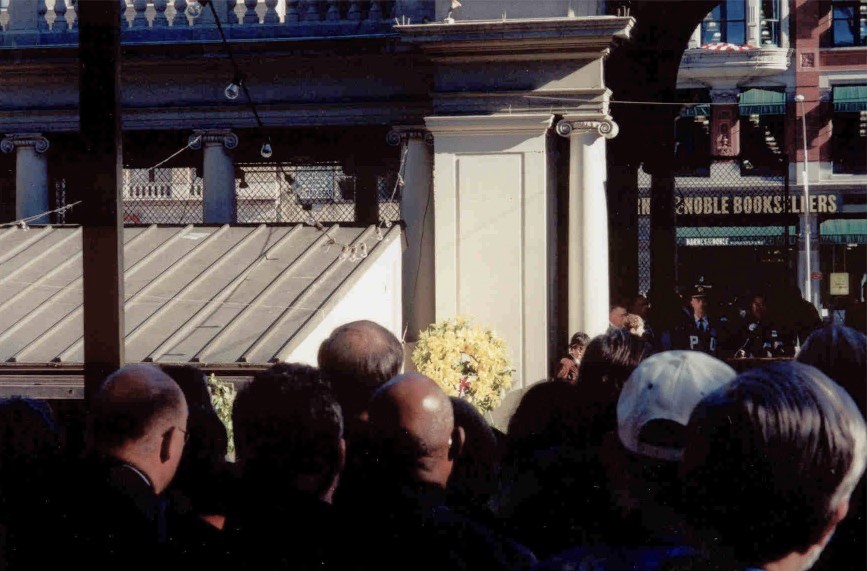
It was cold, and after a while we got bored and wandered over to the side, where we could see a little better but hear even less. But at least it was in the sunshine.
We wandered back to the south side of the park. On the fence that encircled the statue of Washington on horseback was a sort of makeshift shrine. Flowers had been woven through the wire and letters taped to the fence, letters from people in other places sending their sympathy to the people of NYC. There were signs with pro- and anti-war slogans, a quote from John Lennon’s imagine.
And there were also several pages with this quote: “You are what you have been. You will be what you are now.” –Buddha. Out of all the emotional things on that fence, that affected me the most. It gave me the sense of the whole world balanced on a single moment. Every single moment. And here was I—were we—was the city—the entire world—poised on the cusp, the very brink; of war, of uncertainty, disease, poverty and fear. And that is how the world gets on from moment to moment.
I realize that there are probably scores of similar shrines in Manhattan. Just a little while later, we saw a subway police station that had a similar one out front, with names and pictures of their dead, memorials, letters and candles. We also saw similar shrines in front of firehouses. But that was how this one affected me. I felt like I was at an epicenter, at the right place at the right time. And that’s a good feeling, one of my reasons for traveling. From that moment, our junket began to take on elements of a pilgrimage.
We ducked into Virgin Records for a moment to get warm. Saw a John Lennon display. Then we caught the subway uptown. We ran into a woman who was also wearing an “Oregon (Heart) NY” button. (We were wearing ours because New Yorkers were apparently aware of our group, even though we aren’t normally pin-wearing people. Today was the first day someone thanked us for coming.) She started chatting with us. It was her first time in New York (she seemed kind of small town) and she was annoyed that people here pronounced her home state “Orry-gone.”
“I keep telling them,” she said exasperatedly, “we’re not GONE, we’re HERE!”
She stood up at the stop nearest the hotel. “This is our stop,” she said.
“We’re going uptown,” I said a little smugly. Here we were, veterans of the Paris and London subway systems, riding the NYC subway again.
Pride goeth before a fall. We emerged from the subway, I took our bearings and led what I thought was west. It wasn’t. After going four very long blocks, we ended up at something called John Jay Park, where there were some guys playing squash. I checked the map again and found my mistake and we caught a cab (we were getting good at this.) The driver was a Sikh with beard and turban, and he was playing a tape of some kind of speech in a foreign tongue. He said nothing to us. I wondered if he was worried about being mistaken for a terrorist, but I didn’t ask.
The Met was nice, but I wasn’t that impressed. I must not have been in the mood.
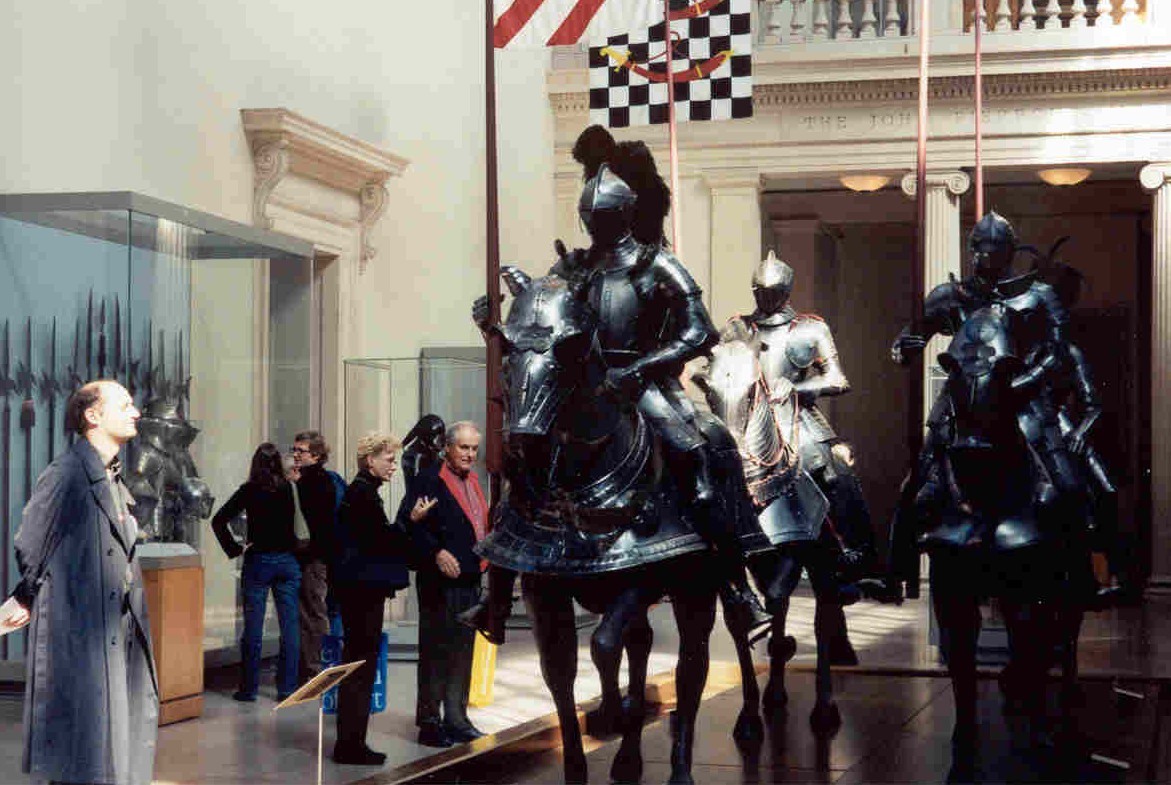
Highlights: The sarcophagi and Egyptian collection; the Temple of Dendur, a gift from the Egyptian government from the site of the Aswan Dam. (It’s where a scene from When Harry Met Sally was filmed: “Today I have decided that we will talk like this.”) It’s extremely well presented, with a little waterway to represent the Nile. We saw a little of the American collection—some beautiful Tiffany glass, along with an Egyptian-style column also by Tiffany. An outstanding (and enormous!) fireplace from the Vanderbilt mansion. Beautiful American furniture. There was a Breughel print exhibit that we barely glanced at—I always want to see the important pieces when I’m in a new museum—even though I love prints. There was also some very nice armor, including a row of knights on horseback, lances couched.
Increasingly, our favorite items were benches—we sat on a very nice one in a roofed-in courtyard, surrounded by American sculptures. Another good one by some Courbet nudes (L gave me a hard time for that!). But the best one was a quiet bench by a tomb in the medieval section, with a string quartet playing in the next room.

At the gift shop we bought postcards and I splurged on (of all things) silk tie with a nice Jazz Age pattern in black and blues. I’ve never felt the urge to buy a tie in my life—I’m not sure why I did now. Another cusp, I suppose. I’ll be stepping over into adulthood any day now, no doubt.
We were running low on time, so we caught another cab to Broadway (Sikh #2—clean shaven, no turban.) The Met lobby was packed when we left.
We got out at the theater, a little early. Dropped in at will-call to beat the crowds—there was still a short line, but people weren’t getting tickets. Lucky thing we bought them when we did.
Went to a pizzeria a few storefronts down from Sardi’s and bought slices. The joint was a lot like Escape From New York Pizza in Portland, almost the same floor plan, but with real Italians (real friendly, too) behind the counter instead of urban hipsters.
We sat next to a nice older lady who seemed to want to talk. It turned out she was going to the same play we were. “I’m not that excited about Strindberg,” she said, “but I want to see that young woman who plays the detective on that PBS show—you know the one.” (We didn’t.)
“Strindberg, yeah. It’s probably dark,” I said. Out of my boundless knowledge of Scandinavian theater.
“It could go either way,” she said.
She hadn’t really been hungry, but had wanted to get out of the cold—there was a bitter wind that day. She was interested in the Oregon trip.
She was the one who told us the US had begun bombing Kabul. She’d heard it just as she left the apartment. We said goodbye and strolled up to Times Square for a couple minutes before the wind drove us back. The jumbo reader board confirmed the bombing. It felt historic, to be in Times Square, where people have gathered for news for at least 70 years, to read about the beginning of a war from the side of the old Times building.
It took us a while to figure out that “Broadway play” doesn’t mean “play” so much as “musical.” There are maybe four musicals that I can tolerate—and then only on film, with my finger on the fast-forward button. L hates musicals, too.
So we didn’t go see “The Producers” or “Mamma Mia!” or “Aida” (the musical, not the opera) or “The Lion King.” We went to “The Dance of Death” by August Strindberg.
We had the worst seats in the house—which still weren’t bad. They were up against what would’ve been the back wall if there had been one. Instead, it was just a short divider over which you could hear the ushers whispering.
Most of the people there were older (and, I suspect, local.) The white-gloved ushers (dressed like ushers, as the maids at the Waldorf were dressed like maids) scurried to get everyone in their seats before curtain. One, a youngish, very Jewish-looking usher, was clearly stressing out.
The theater was The Broadhurst, opened by the Schubert Brothers and a playwright named George Broadhurst in 1917. Previous actors and plays include: Jack Lemmon in “Long Day’s Journey into Night,” Dustin Hoffman in “Death of a Salesman,” Katherine Hepburn, “Cabaret,” Ingrid Bergman, Woody Allen in “Play it Again, Sam,” Rosalind Russell in “Auntie Mame,” Helen Hayes, and Leslie Howard and Humphry Bogart in “The Petrified Forest.” A lot of theater history.
Our play starred Sir Ian McKellan (who had starred here as Salieri in “Amadeus”) Helen Mirren and David Strathairn (whom I’ve always liked.) A worthy addition to the list, I think.
Near the beginning of the first act, the nervous usher was talking loudly behind us. It probably made him really nervous to do so, but the man he was talking to was about 120 years old and hard of hearing. Finally, the old guy doddered down the aisle and peace ensued.
The play was okay; somewhat dark, but funny. But the performances were great. McKellan and Mirren really crackled together, and when Strathairn came on, I thought, “Man, how is he going to stand up to them?” But he did fine. His character, as written, was weaker than the other two, but he brought moments of strength to it, just as needed. And the other two characters were themselves playing roles—perfect for two famous stage veterans.
(In one scene McKellan goes to the wings and picks up a cat. The old people on L’s side, who seemed nice—they’d chatted with L before the play—had the following conversation: Man: “Is that a cat?” Woman: “No, that’s a CAT!”)
After the play, we rushed around trying to get a taxi—just like everyone else who’d just gotten out of matinees. A block off of Broadway there was a bronze sculpture sitting on a trailer at the side of the street—it was, a sign said, dedicated to the rescuers at the WTC.
Finally caught a cab—driven by Sikh #3—back to the hotel. Suddenly there was serious security at the Waldorf entrance. (Because of the war? Were we—here in defiance of terrorism—possible targets?)
We were just in time to go to dinner with the Oregonians—they were already lining up in the lobby. I tried to take our shopping bag up to our room, but I must’ve been crashing and couldn’t figure out which elevator to take. I finally came back with it.
We ended up on the last bus out. They were British-style double-deckers, and no one wanted to ride topside, because it was so cold and the wind was like a knife.
“Let’s sit in the back,” said L as we got on the bus.
“With the troublemakers!” said a woman already sitting there.
“With the troublemakers,” said L, smiling.
We talked. The couple was maybe 15 or 20 year older than us. The man was polite enough but absorbed in the scenery (as I would’ve been if I weren’t in the middle.) Once he looked up and said, “Is that Times Square?” It wasn’t.
The woman told us how they’d gone to church in Harlem that morning and people had thanked them for coming and said, “God bless you.” I was a little jealous. No one had blessed us at the art museum.
Going through Soho, we passed a shop called “Yellow Rat Bastard.”
“You went to a play?” asked the woman. “Which one?” When we told her “Dance of Death” she looked at us blankly. Well, it was still in previews.
She went on to tell us that they’d been to Tavern on the Green and when the manager heard they were from Oregon, he gave them (I think) free champagne.
When I jokingly told her that she’d jinxed me (for some reason) she half-seriously made some hand gestures over me while saying rapidly, “Lord-Jesus-protect-this-man…” and so on (I really didn’t catch much of it.) Then she looked at me triumphantly, as if she’d averted a curse. She was probably thinking it a blessing; I was thinking voodoo and chicken blood.
I had been feeling like we didn’t fit in with this crowd at all—we were younger, probably less affluent, maybe less complacent—and I knew that as a war was coming on, conformity may well be the name of the game. And yet here I was (I now see) judging someone. Instead of delighting in diversity. And diversity was what NYC was all about.
The bus stopped suddenly and we all filed off. We were directed to a yellow and red sign that said “Harmony Palace.” There was a line to get in, and I wondered if there was going to be room for all of these people?
We came into a very large room, full of people and circular tables. The tables all seemed to be full, though. When a man on the dais asked people to raise their hands if there was an empty seat at their table, and a show of fingers for the number of available seats, L headed immediately for the nearest table with two seats open. Which turned out to be a table of Chinese VIPs two tables from the front.

“You happen to be sitting at a table with some very important people in the Asian community,” said the woman sitting next to me.
Her name was Ellen Young (which was funny, because that’s my Aunt Ellen’s name) and she was very gracious. She introduced us to everyone at the table, although I missed much of it because my blood sugar was really low and I could barely hear her (the hubbub was considerable).
Several people handed us their business cards (I, of course, don’t have any and L hadn’t brought any) and it’s from these and because L asked Ellen for a list later, that I can give you the names of the people at our table (I think left to right): Milton Huang of the “International Daily News;” Gwo Kuen Chen, Contributing Editor of the “Liberty Times”; Kevin Chu of Jou Wing’s Imaging and Printing; Hui Ching Wang, a singing teacher; Hsin Yuan Cheng, president of Sino Radio Broadcasts and Consultant to the Committee of 100; and Charles Wang, I think a news photographer.
Ellen Young herself gave us two business cards, one of which declared her to be Constituent Service Director for a NYC city council candidate named John Liu. The other said she was a consultant for Ellen Young Immigration Services Inc., as well as Immigration Policy Study Chair for the Asian American Public Policy Forum and a Radio Talk Show Host for Chinese American Voice Radio. (The back of the second card is a sea of Chinese characters.) She seemed very nice, but also very political. I felt pretty provincial, and had no idea what to say most of the time.
At first I thought they were being very nice in sharing their food with us. Then I caught on that it was the same communal food at every table, one course at a time. There were ten courses (none of which, I’m afraid, I enjoyed very much.)
My blood sugar must’ve been very low, because I was quietly performing slapstick routines. First I dropped my napkin. We were so squeezed into those tables that I had a hell of a time retrieving it surreptitiously. Then I ended up with an enormous piece of Mongolian beef. I couldn’t cut it, so I popped it into my mouth. Fortunately, there was a speech at the time, so I could look away. Thank god no one tried to talk to me.
There was a lion dance (which I’d seen twice before, once at WWU and once in Vancouver, BC’s Chinatown.) Ellen said, “It’s a Chinese custom to put money in the lion’s mouth for luck.”
Oregon Congressman David Wu gave a pretty good speech. He told a probably apocryphal but stirring story about American soldiers landing in France when the US entered WWI and announcing, “Lafayette, we have arrived!” Repaying an ancient debt. He related it to what we were doing there—from Astoria to NY, city of the Astors. “New York, we have arrived!” (Not too convincing to the cynic Keith.)
“Have you been to a Broadway play?” asked Ellen. “Which one?” Another blank stare.
Ellen introduced us to various people—the first Asian NYC councilman and a man whom she said would probably succeed the man they call, “The Mayor of Chinatown” (whom we didn’t meet, but who addressed the room in a short, inaudible speech). She even knew the governor of Washington (who was Asian) and had contributed to his campaign.
The valedictorian of Portland’s Grant High School was coaxed into leading us in the National Anthem. She was a fresh-faced black girl who approached the mic and said, “Ya’ll are going to sing along, right?” And then Hui Ching Wang, the singing teacher from our table, sang a very nice “Star Spangled Banner.”
Ellen proposed a toast which neither L nor I caught all of—something about new friends from far away—and showed us how to drink with one hand under the glass’s bottom—”to show honor” to the people you were drinking with. Then she interviewed us, and later told us via email that she’d shared her experiences of that night on her radio show, with 200,000 listeners.
And then suddenly it was all over, and people were filing out of the building. L exchanged email addresses with Ellen (“To our new friend from far away,” L wrote above hers.) A number of us had our pictures taken together, and David Wu was posing with the army of waiters and busboys who had just efficiently emptied the tables.
After we had thanked Ellen for her hospitality and were making for the door, the woman from the bus came up to us. “Did you have a good time?” she asked. “We ended up sitting next to a nice couple from Bend.” “We sat with people from Chinatown,” said L with satisfaction.
On the ride back, we sat in front of some friendly ladies in their 50’s, one of whom was from Bellevue, WA and another who had gone to Our Lady of Lourdes (a Catholic school in Vancouver, WA that L had attended a few years).
In the elevator up to the room, some bossy guy told us out of the blue, “Don’t forget—6 AM tomorrow.” They wanted us to show up in force for the “Good Morning America” TV show. L and I discussed going and characteristically decided, “Screw that!” It was going to be a struggle to get up early enough just to make the 9:30 Columbus Day Parade deadline; we were still operating on a massive sleep deficit.
We laid around the room and watched the news of the shelling in Afghanistan. Then I took a bath, my only disappointment with the Waldorf. The drain was set so low that the water didn’t even cover me—damn modern plumbing! While I sat in the tub, L & I went over our memories of the first day of our trip, L taking notes. We went to bed very tired. It had been quite a day.
10-8-01—The Waldorf was a quiet place. It wrapped you up in a big, safe blanket of silence. All you ever heard was the fan and the distant cacophony of car horns—no hall noises, no TVs, no shouting. But on this morning, there was a noise—a long, rolling sound like thunder, and then a boom. It sounded quite close.
It woke me, and I strained to listen, hoping to hear a clue to what it had been. The horns sounded the same as usual, but had they ceased after the Towers had come down? Probably not.
My mind was filled with wild imaginings—all the acts of terrorism that the TV news in the last three weeks had hinted were possible: bombings, poisonings, atomic weapons…My god, what were we doing here? We’d set ourselves up as targets, coming during a time of instability to the biggest city in the country, and an island to boot! Had we learned nothing from the Y2K manuals? This reaction surprised me a little. I’d decided, in some unexamined corner of my mind that I had come to terms with the idea of my own death. (As if anyone ever does, until it’s staring them in the face.) I was surprised how much I wanted to live.
But then, an odd thing: I thought about the day before, all the things we’d done, places we’d been. A feeling grew in me that despite occasional misgivings of the world teetering on the brink of war, despite the somewhat fin-de-siecle atmosphere here…well, it felt like we were in the right place at the right time. And that’s a feeling we don’t get often enough in our short, uncertain lives. I was filled with a deep happiness, and laid there warm and happy until the $500 clock radio turned over to 8:30. Then classical music started low, and got louder. (I watched the volume numbers get higher.) And that was a happy event, too, even though the music was sad.
(By the way, it turned out that there was a service corridor beyond the next wall, and the noise that woke me had been a metal cart rolling over a cement floor, then crashing into another one.)

 KEITH SCHEID, Author
Looking forward to hearing what you think!